Most ITAD buyers ask the wrong question.
They ask: “Are you certified?”
They should ask: “Certified for what, exactly?”
Before you can evaluate any certification claim, you need a baseline for what legitimate ITAD services actually look like in practice.
Because here’s the problem: the ITAD industry throws around certifications, standards, compliance frameworks, and documentation requirements like they’re all the same thing. They’re not. And that confusion is exactly how organizations end up trusting vendors with impressive logos and weak processes.
A recycler badge doesn’t prove your data was destroyed. A standards framework doesn’t guarantee chain of custody. And a generic certificate of destruction doesn’t tell you whether the vendor can actually account for every device you handed over.
This guide breaks down what ITAD standards and certifications actually mean, which ones matter for data security versus environmental compliance, and most importantly, what proof you should demand before trusting any ITAD provider with your organization’s retired IT assets.
TL;DR
The quick version of what actually matters in ITAD standards and certifications.
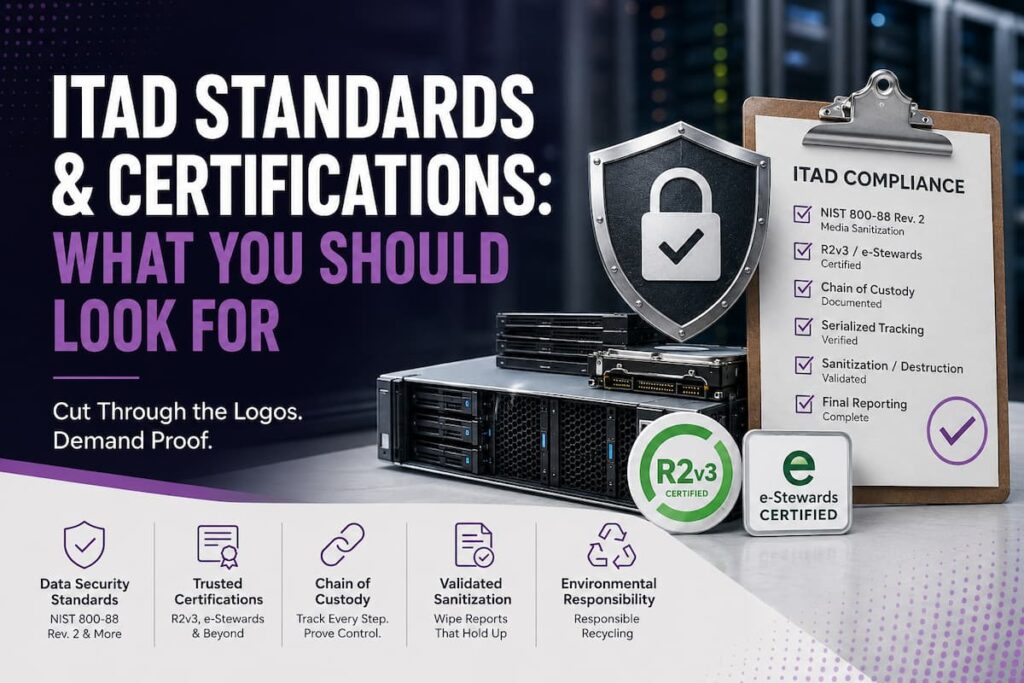
ITAD standards guide how data-bearing devices should be handled, like NIST 800-88 Rev. 2 for media sanitization.
ITAD certifications validate certain programs, systems, or downstream recycling practices, like downstream recycling compliance standards (such as e-Stewards).
Neither matters much without chain of custody, serialized tracking, validated sanitization, and final reporting tied to actual assets.
The right ITAD provider doesn’t just say “we’re certified.” They can prove control at every step, from pickup through final disposition.
ITAD Standards vs. ITAD Certifications: Not the Same Thing
Let’s start with the definitions most competing pages skip:
Standards are frameworks and guidance. They define how work should be done. NIST 800-88 Rev. 2 is a standard. It provides technical guidance for media sanitization but doesn’t certify anyone.
Certifications are outside validations of a recycler, process, or management system. compliant recycling standards and e-Stewards are certifications. They verify that a company meets specific recycling and downstream management criteria.
Proof is the documentation you actually need later. Chain of custody records, serialized asset tracking, validated wipe reports, and certificates of destruction or sanitization tied to specific devices.
Here’s the critical insight most buyers miss:
A vendor can hold impressive certifications and still hand you weak documentation. They can mention standards compliance and still fail to track individual assets. And they can claim to follow “best practices” while providing nothing you could show an auditor six months later.
The real question isn’t “What are you certified for?” It’s “What can you prove happened to each of our assets?”
The ITAD Standards That Matter Most
NIST 800-88 Rev. 2: The Current Media Sanitization Standard
NIST Special Publication 800-88 provides technical guidance for sanitizing data-bearing devices. It’s not a certification badge. It’s a framework that defines how to make data recovery infeasible for a given level of effort.
Here’s what matters right now: NIST’s official page shows that SP 800-88 Rev. 1 was withdrawn on September 26, 2025 and superseded by Revision 2. A lot of ITAD content still references Rev. 1 like it’s current. If a vendor’s website or marketing materials cite outdated guidance, that’s your first red flag.
NIST defines three sanitization methods:
- Clear — logical techniques like overwriting
- Purge — physical or logical methods that make data recovery infeasible even with state-of-the-art laboratory techniques
- Destroy — physical destruction of the media
The key principle: the right method depends on the device type, data sensitivity, and whether the equipment has reuse value. NIST doesn’t mandate “destroy everything.” It mandates appropriate risk-based decisions.
When a vendor says they’re “NIST-compliant,” ask which revision they follow and how they document sanitization method selection for each asset class.
Regulatory and Industry Obligations That Shape ITAD
These aren’t “ITAD certifications,” but they absolutely affect how the work must be done:
HIPAA requires covered entities and business associates to implement policies ensuring electronic protected health information (ePHI) is properly destroyed or sanitized before disposal.
GLBA (Gramm-Leach-Bliley Act) mandates that financial institutions dispose of consumer information in a manner that prevents unauthorized access.
SOX (Sarbanes-Oxley) doesn’t explicitly address IT disposal, but its audit trail and record-keeping requirements mean organizations need defensible documentation of how financial data on retired systems was handled.
FERPA governs educational records, and institutions must ensure student data is not improperly disclosed through equipment disposal.
Add to that state privacy laws, internal security policies, legal hold requirements, and sector-specific mandates, and you see why generic “certified recycler” claims don’t cut it.
We work with healthcare systems, financial services firms, legal practices, and government agencies where compliance isn’t optional. The ITAD process has to match the regulatory reality, which means documentation that survives audits, not just marketing that sounds compliant.
The ITAD Certifications Buyers See Most Often
Responsible Recycling (R2) Certification
R2 (Responsible Recycling) is a standard specifically for electronics recyclers. compliant recycling standards is the current version.
What it signals: The certified facility has systems in place for environmental management, data security practices, and downstream vendor controls. It addresses worker safety, downstream tracking, and responsible material handling.
Why it matters: It proves the recycler isn’t just dumping equipment in a landfill or shipping it overseas without accountability. For organizations concerned about where their retired hardware ultimately ends up, compliant recycling standard certification is meaningful.
What it doesn’t prove on its own: Serial-level tracking of your assets. Chain of custody for your job. Validated sanitization tied to your devices. What happened when a specific drive failed validation.
We manage certified downstream recycling compliance, but we also know that downstream certification alone doesn’t answer the operational questions buyers should be asking about pickup, intake, tracking, and reporting.
e-Stewards Certification
e-Stewards is another electronics recycler certification, often positioned as more stringent than R2 on environmental and social responsibility criteria.
Where it fits: Organizations with strong sustainability priorities or public commitments to responsible recycling may prefer e-Stewards-certified vendors.
Why some buyers care: Stricter controls on export, landfill diversion, and prison labor. More aggressive environmental standards.
Like downstream recycling compliance standards, e-Stewards certifies the recycler’s program. It doesn’t automatically validate how your specific job was handled at the asset level.
Security and Process-Adjacent Validations
Beyond recycler certifications, you’ll encounter references to:
Validated overwrite tools like Blancco, which provide software-generated reports proving a wipe passed or failed at the sector level.
Certificates of destruction that document physical destruction events.
Certificates of sanitization that confirm successful data erasure.
Audit logs and asset-level tracking that tie every action back to specific serial numbers.
These aren’t formal third-party certifications in the R2/e-Stewards sense, but they’re often more relevant to your actual data security risk. A Blancco report showing a drive passed NIST-compliant overwriting is proof. A generic recycler badge is a program credential. When we handle secure data destruction, we’re focused on validated sanitization tied to individual assets, because that’s what holds up when compliance asks questions.
What Certifications Do Not Tell You by Themselves
This is the section most competing pages avoid, because it’s uncomfortable for vendors hiding behind logos.
Certifications don’t prove:
- How pickup was controlled — Was chain of custody established at load-out, or did equipment just disappear into a truck?
- Whether assets were serialized at intake — Can you trace a specific laptop by serial, or just “47 laptops, mixed models”?
- Whether wipes were validated per device — Did you get a Blancco report for serial #ABC123, or a summary sheet saying “batch wiped”?
- What happened to failed media — When a drive fails sanitization, was it escalated to destruction? Do you have proof?
- Whether your audit trail will hold up — If compliance asks “what happened to laptop serial XYZ,” can you produce documentation in 60 seconds?
A vendor can be compliant recycling standard certified and still give you a generic one-page summary with no asset-level detail. They can reference NIST and still use unvalidated freeware tools. They can claim “secure handling” and provide zero chain-of-custody documentation.
The certifications tell you about the vendor’s program. The proof tells you about your job.
What to Ask an ITAD Vendor Before You Hand Over Assets
Turn these into hard requirements, not soft preferences:
Do you follow NIST 800-88 Revision 2? Not Rev. 1. Not “NIST-aligned.” The current standard.
Do you provide serialized intake and asset-level tracking? Can you account for every device by serial, or just batch counts?
What does your chain-of-custody record include? Timestamps? Operator names? Handoff documentation? Or just “we picked up your stuff”?
What happens when a drive fails wipe validation? Is it automatically escalated to destruction? Do you get a separate certificate? Or does it just vanish into “recycling”?
Do you provide certificates of destruction and/or sanitization? Are they tied to specific assets, or generic batch receipts?
How do you control downstream recycling partners? If you’re compliant recycling standard certified, how does that certification extend through your downstream vendors?
Can you support multi-site, remote, and endpoint-heavy environments? Can you handle branch offices, remote employees, and distributed device returns, or only loading-dock pickups at headquarters?
What does your final reporting packet actually look like? Can you show a sample? Not marketing copy. Actual documentation.
What Good ITAD Documentation Should Look Like
Here’s what you should receive after an ITAD job, and what we deliver on every engagement:
Itemized asset tracking — Every device cataloged by make, model, serial number, and asset tag (if applicable).
Serialized intake records — Documentation showing when each asset entered custody, in what condition, and under whose authority.
Chain of custody — Clear records of every handoff, from pickup through final disposition.
Wipe confirmation or destruction certificates — Proof that sanitization occurred (with pass/fail status) or that physical destruction was completed.
Reconciliation reporting — Final disposition tied back to the original inventory so you can account for every asset.
Audit-ready formatting — Documentation structured so compliance, legal, or your auditor can review it without decoding vendor jargon.
Vague summary sheets don’t cut it. “We processed 47 laptops and 12 monitors” tells you nothing. Serial-level reporting tied to validated sanitization or certified destruction is what survives an audit.
That’s the standard we hold ourselves to as a certified ITAD solutions provider, because we know our clients operate in regulated environments where “trust us” isn’t documentation.
Why NIST Alignment Matters More Than Generic “Data Destruction” Claims
Let’s be blunt about what doesn’t count as data destruction:
Deleting files isn’t sanitization. The data is still recoverable.
Factory reset isn’t proof. It’s a user-level command, not validated overwriting.
Reformatting doesn’t meet NIST standards for media sanitization.
“We wiped it” without documentation is a claim, not proof.
Real data destruction under NIST 800-88 Rev. 2 requires:
- Method selection appropriate to the media type and data sensitivity
- Validation that the process completed successfully
- Documentation tying the sanitization or destruction event to a specific device
- Exception handling when validation fails (e.g., failed drives escalated to physical destruction)
This is why we use validated overwrite tools and provide wipe reports at the asset level. When a drive passes, you get proof. When it fails, it’s escalated to certified destruction, and you get proof of that, too.
Generic “data destruction” language without specifics is a red flag. NIST Rev. 2 alignment with validated reporting is the standard.
The Hidden Standard Nobody Talks About Enough: Operational Control
Most ITAD content obsesses over certifications. Almost none of it talks about what actually makes or breaks a job: operational discipline.
Secure pickup — Is equipment loaded into a tracked vehicle with documented chain of custody, or just tossed in a truck?
Packaging and transit — Are drives secured during transport to prevent loss or tampering?
Multi-site coordination — Can you handle 15 branch offices shipping devices back to a central facility, or only loading-dock pickups?
Remote-user returns — What happens when an employee in another state has a company laptop? Do you provide prepaid shipping with tracking?
Intake discipline — Are devices photographed, inventoried, and serialized on arrival, or just dumped in a pile?
Exception handling — When something doesn’t match the manifest, or a drive fails sanitization, or a device arrives damaged, what’s the protocol?
Final reporting consistency — Do you get the same quality documentation every time, or does it vary by location, operator, or project size?
These aren’t certification criteria. They’re the operational details that determine whether your ITAD process is defensible or a liability in waiting.
We’ve built our process around these realities because we work with organizations that can’t afford gaps. Healthcare systems with HIPAA obligations. Financial firms with GLBA requirements. Law firms with chain-of-custody expectations. Government agencies with audit mandates. The certifications matter. The operations matter more.
Why the Best ITAD Programs Don’t Destroy Everything
Here’s a principle most ITAD vendors won’t say out loud because it complicates their sales pitch:
Destroying everything is easy. Smart triage is harder.
Physical destruction eliminates data risk, but it also eliminates any residual value in the equipment. And for organizations running regular refresh cycles, that lost value adds up fast.
The better approach:
Wipe what should be wiped — Devices that pass NIST-compliant validated sanitization can be resold, redeployed internally, or donated. You recover value while maintaining security.
Destroy what should be destroyed — Failed drives, damaged media, or devices handling data too sensitive to risk remarketing get escalated to certified physical destruction.
Document both — Whether an asset was sanitized or destroyed, you get proof tied to that specific device.
This isn’t about cutting corners. It’s about recognizing that compliant data sanitization and value recovery aren’t mutually exclusive when the process is controlled and documented.
We position ourselves as a reuse-first provider because we know our clients don’t want to pay to destroy equipment that could offset refresh costs, as long as the sanitization process is validated, documented, and audit-ready. For a deeper look at how this balance works, see our guide on What is IT Asset Disposition.
Destruction matters. Over-destruction kills recoverable value. The real answer is triage, not theatrics.
What You Should Actually Look for in an ITAD Provider
Here’s the decision framework:
1. Current sanitization standard alignment — Do they follow NIST 800-88 Rev. 2, or are they citing outdated guidance?
2. Relevant downstream/recycling certification — downstream recycling compliance standards (such as e-Stewards) for responsible material handling.
3. Chain of custody — Documented handoffs from pickup through final disposition.
4. Asset-level serialized tracking — Can they account for every device individually, not just batch counts?
5. Validated wipe or destruction proof — Certificates tied to specific assets, not generic summaries.
6. Final reporting quality — Audit-ready documentation you can pull up in 60 seconds when compliance asks.
7. Recovery-value capability — Can they preserve resale or redeployment value for assets that pass sanitization, or do they default to destruction?
8. Experience with regulated and distributed environments — Have they handled healthcare, financial, legal, government, or multi-site enterprise ITAD before?
This isn’t a “nice to have” list. It’s the minimum standard for defensible ITAD.
As a Boston ITAD and wholesale OEM toner provider, we’ve built our process around these requirements because we know the organizations we serve can’t afford gaps. Compliance isn’t optional. Chain of custody isn’t negotiable. Proof isn’t a luxury.
Final Answer: Certifications Matter, but Proof Matters More
Let’s close where we started:
Certifications matter. compliant recycling standards and e-Stewards validate responsible recycling. NIST 800-88 Rev. 2 provides sanitization guidance. HIPAA, GLBA, SOX, and FERPA shape compliance obligations.
But certifications aren’t enough by themselves.
The real test is whether the ITAD provider can prove what happened to each asset, from the moment it left your building through final disposition.
Can they show:
- ✅ Serialized intake at pickup?
- ✅ Chain of custody through every handoff?
- ✅ Validated sanitization or certified destruction tied to specific devices?
- ✅ Final reporting that reconciles back to your original inventory?
- ✅ Documentation that holds up when compliance, legal, or your auditor asks questions six months later?
If the answer is yes, you’re working with a real ITAD provider.
If the answer is “trust us” or “we’re certified,” you’re working with a hauler with good marketing.
Strong ITAD isn’t about collecting acronyms. It’s about proving control.
Frequently Asked Questions About ITAD Standards & Certifications
Direct answers to the most common questions about ITAD standards, certifications, documentation, and vendor evaluation.
What are ITAD standards?
ITAD standards are frameworks and guidance documents that define how IT asset disposition should be performed. The most important is NIST Special Publication 800-88 Rev. 2, which provides technical guidance for media sanitization. Standards set expectations but don’t certify individual vendors.
What are ITAD certifications?
ITAD certifications are third-party validations that a recycler, processor, or service provider meets specific program requirements. compliant recycling standards and e-Stewards are the most common, focused on responsible recycling, environmental management, and downstream controls.
Is NIST 800-88 a certification?
No. NIST 800-88 is a technical guidance document, not a certification. It defines sanitization methods (clear, purge, destroy) but doesn’t certify vendors. When a provider says they’re “NIST-compliant,” they mean they follow the guidance, but you should ask for proof of how they implement and document it.
What is the difference between R2 and e-Stewards?
Both are electronics recycler certifications. compliant recycling standards focuses on responsible recycling, data security practices, and downstream vendor controls. e-Stewards is generally considered more stringent on environmental and social responsibility criteria, with stricter controls on export, landfill diversion, and labor practices. Both validate the recycler’s program; neither proves asset-level handling of your specific job.
What certifications should an ITAD provider have?
At minimum, look for downstream recycling compliance certification (such as e-Stewards) for downstream recycling accountability. But certification alone isn’t enough. You also need serialized asset tracking, chain of custody, validated sanitization or destruction proof, and final reporting tied to actual devices.
What documentation should an ITAD vendor provide?
Expect itemized asset lists by serial number, chain-of-custody records, validated wipe reports or destruction certificates tied to specific assets, reconciliation back to your original inventory, and final disposition documentation structured for audit review.
What is chain of custody in ITAD?
Chain of custody is documented tracking of who had control of assets at every step, from pickup through final disposition. It should include timestamps, operator identification, handoff records, and location tracking. Without it, you can’t prove what happened to equipment after it left your facility.
Does certification prove data destruction compliance?
No. Certifications like downstream recycling compliance standards (such as e-Stewards) prove the vendor meets certain program standards. They don’t prove your specific data was destroyed, how it was sanitized, or what happened to individual assets. Compliance proof comes from asset-level documentation: serialized tracking, validated wipe reports, destruction certificates, and final reconciliation.
What should I look for in an ITAD provider?
Look for NIST 800-88 Rev. 2 alignment, relevant recycler certification (downstream recycling compliance standards (such as e-Stewards)), chain-of-custody control, serialized asset tracking, validated sanitization or destruction proof, audit-ready final reporting, value recovery capability, and experience with regulated environments like healthcare, finance, or government.
Is destroying every drive the safest option?
Destruction eliminates data risk, but it also eliminates any residual value in the equipment. The smarter approach is triage: wipe what should be wiped with NIST-compliant validated sanitization, destroy what should be destroyed, like failed drives, damaged media, or policy-required destruction, and document both. Security and value recovery can coexist when the process is controlled and documented.
How do I know if my current ITAD vendor is actually compliant?
Ask them to produce sample documentation from a past job: serialized asset intake records, chain-of-custody logs, validated wipe reports tied to specific devices, and certificates of destruction where applicable. If they can’t show you what their documentation looks like before you sign a contract, that’s your answer.
Can an ITAD provider be compliant recycling standard certified and still provide weak documentation?
Yes. compliant recycling standards certifies the facility’s recycling program and downstream management systems. It doesn’t guarantee asset-level tracking, validated sanitization reports, or audit-ready documentation for your specific job. Always ask what documentation you’ll receive, not just what certifications the vendor holds.
What happens if a hard drive fails the sanitization process?
Failed drives should be escalated to certified physical destruction. You should receive a certificate of destruction specifically for those assets, clearly identifying them by serial number and documenting the destruction method and date. If a vendor can’t explain their failed-drive protocol, walk away.
Do I need different ITAD processes for HIPAA vs. GLBA compliance?
The core requirements overlap significantly, both demand documented data destruction and audit trails. However, HIPAA specifically addresses PHI/ePHI, while GLBA focuses on consumer financial information. Your ITAD provider should understand the regulatory nuances and provide documentation formatted for your specific compliance framework.
What’s the difference between a certificate of destruction and a certificate of sanitization?
A certificate of destruction documents physical destruction of media or devices, such as shredding, crushing, or incineration. A certificate of sanitization documents successful data erasure through validated overwriting. Both should be tied to specific serial numbers and include method, date, and facility information.
Can I remarket equipment that’s been through ITAD?
Yes, if it’s been properly sanitized to NIST standards with validated wipe reporting. Equipment that passes sanitization can be resold, redeployed internally, or donated, recovering value while maintaining security. Failed drives or devices with damaged media should be destroyed, not remarketed.
How long should I keep ITAD documentation?
Follow your organization’s record retention policy and regulatory requirements. Healthcare organizations under HIPAA typically retain records for 6+ years. Financial services firms under GLBA may have similar or longer requirements. When in doubt, treat ITAD documentation like any other compliance record with multi-year retention.
What if I have devices at remote locations or with remote employees?
Your ITAD provider should support distributed collection, either through prepaid shipping with tracking or coordinated multi-site pickups. Chain of custody becomes even more critical in distributed scenarios. Make sure your provider can maintain documentation integrity across multiple collection points.
Is there a difference between ITAD for laptops vs. servers vs. mobile devices?
Yes. Laptops and mobile devices, endpoints, are often distributed, making collection and chain of custody more complex. Servers may contain higher volumes of sensitive data and often require on-site sanitization before transport. Storage arrays need specialized handling. Your ITAD provider should have experience with your specific asset mix.
What should I do if my current vendor can’t provide the documentation I need?
Start by clearly communicating your requirements: serialized tracking, chain of custody, validated wipe reports, and audit-ready final reporting. If they can’t or won’t deliver, find a provider who can. The cost of weak documentation far exceeds any savings from a cheap vendor when compliance questions arise.