Most companies think ITAD compliance happens at the end — when the shredder runs or the certificate arrives.
It doesn’t.
Real compliance risk starts the moment a device leaves active use and begins moving through pickup, transport, intake, sanitization, destruction, remarketing, and reporting.
That’s where the gaps appear. That’s where data gets exposed. That’s where audit trails fall apart. And that’s where regulatory consequences, breach notifications, and public failures begin.
This isn’t about checking boxes or collecting certifications. It’s about reducing risk at every step — from the loading dock to the final report.
Because ITAD data security compliance isn’t a certificate. It’s a controlled workflow that proves what happened to every asset, every drive, and every piece of data.
TL;DR
ITAD compliance is a workflow, not a certificate.
ITAD data security compliance means retiring business technology in a way that protects data and proves what happened.
Risk drops when custody, intake, sanitization, and reporting are controlled.
Risk rises when any of those steps get vague.
Compliance isn’t something a vendor claims. It’s something they prove — with chain of custody, serialized tracking, validated sanitization, exception handling, and audit-ready documentation tied to actual assets.
What ITAD Data Security Compliance Actually Means
ITAD data security compliance is the practice of retiring IT equipment in a way that:
- Protects sensitive data through validated sanitization or certified destruction
- Maintains documented custody from pickup through final disposition
- Proves what happened with serialized tracking and audit-ready reporting
- Meets regulatory obligations like HIPAA, GLBA, SOX, or FERPA where applicable
- Reduces organizational risk by eliminating data remanence, custody gaps, and documentation failures
This is more than destruction. It’s more than recycling. And it’s more than a vendor claiming they’re “certified.”
Real compliance means you can answer these questions six months after the job:
- What happened to laptop serial #XYZ123?
- Was the data sanitized or destroyed?
- Who had custody at every step?
- What validation or destruction method was used?
- Where’s the proof?
If you can’t answer those questions with specific documentation, you don’t have compliance. You have exposure.
Why ITAD Compliance Risk Is Bigger Than Most Teams Think
Old devices still hold sensitive data. Patient records. Financial transactions. Customer information. Proprietary research. Access credentials. Email archives.
And compliance failures often stay hidden — until an audit, an incident response investigation, or a regulator comes asking questions.
The scale of consequences when controls fail:
In February 2024, Change Healthcare (a UnitedHealth subsidiary) suffered a ransomware attack that UnitedHealth later said affected more than 100 million people. While the attack vector was a compromised remote access portal, not retired equipment, it’s a stark reminder of the scale of sensitive-data exposure when security controls break down anywhere in the technology lifecycle.
Regulators are paying attention. In 2025, the UK Information Commissioner’s Office (ICO) fined Capita £14 million over inadequate security measures tied to its 2023 breach — a case where security failures in data handling created regulatory consequences at scale.
Here’s the uncomfortable truth: retired IT assets represent one of the least-controlled points in the technology lifecycle for many organizations. Equipment moves from active networks into storage closets, loading docks, vendor trucks, and third-party facilities — often with weaker custody controls than when the devices were in production.
That’s where compliance risk lives.
Risk Starts at Pickup, Not Destruction
The moment custody changes hands, compliance risk begins.
This is where weak processes look like:
- Equipment loaded into unmarked trucks with no manifest
- Devices handed to a vendor with batch counts, not serial-level tracking
- No documentation of who took custody, when, or under what authority
- Remote employees shipping devices back with no chain-of-custody controls
- Branch offices coordinating their own pickups without central oversight
Chain of custody is the first real compliance control.
It’s the documented record of who had physical control of assets at every step — from the moment equipment leaves your building through final disposition. Without it, you can’t prove what happened. You can only hope.
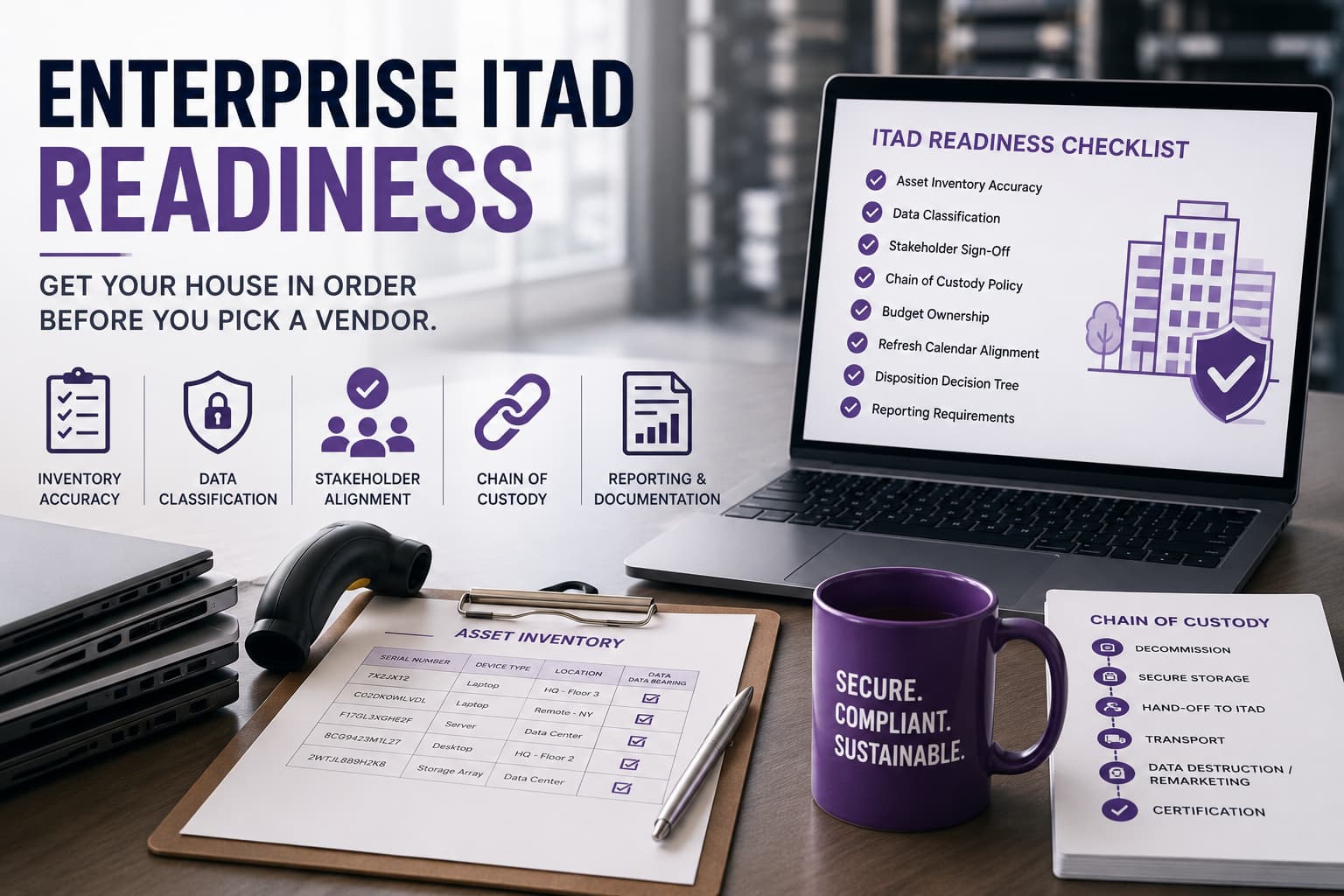
Strong chain of custody includes:
- Date and time of custody transfer
- Identification of individuals involved
- Serial numbers or asset tags of devices transferred
- Location and transport method
- Condition documentation (photos, notes, seals)
- Signatures or digital acknowledgment
This is where ITAD providers either reduce risk or create it. A provider with secure pickup protocols, manifest verification, sealed transport, and documented handoffs gives you defensible records. A provider who “picks up your stuff” gives you nothing.
Weak Intake Creates Stronger Future Problems
What happens when equipment arrives at the ITAD facility matters just as much as how it got there.
Weak intake looks like:
- Batch counts with no serial capture: “47 laptops, mixed models”
- No reconciliation against the original manifest
- Assets dumped into general inventory without serialized tracking
- No condition documentation (intact seals, physical damage, missing drives)
- No intake photos or timestamps
Why this matters:
If assets aren’t serialized at intake, you lose the ability to track what happened to specific devices. When compliance asks “What happened to laptop #ABC123?” and your vendor can only say “It was in the batch we processed,” you have no defensible answer.
Strong intake creates the foundation for everything downstream:
- Every device photographed and cataloged by serial
- Reconciliation back to the pickup manifest
- Discrepancies flagged immediately
- Asset-level tracking established from day one
- Condition documentation captured for audit trail
For organizations managing distributed technology — branch offices, remote employees, multi-site operations — this becomes even more critical. When you’re coordinating returns from 15 locations, intake discipline is what keeps the audit trail intact. Learn more about managing ITAD for corporate devices across distributed environments.
Weak intake at the beginning creates impossible problems at the end.
Sanitization Is Where Weak Claims Get Exposed
This is where compliance failures become data breaches.
What doesn’t count as sanitization:
- Deleting files
- Factory reset
- Reformatting
- “We wiped it” without validation
- Generic freeware tools with no reporting
What does count:
Validated data sanitization following current guidance — specifically NIST Special Publication 800-88 Revision 2, which superseded Rev. 1 when it was withdrawn on September 26, 2025.
NIST defines three sanitization methods:
- Clear — logical techniques like overwriting
- Purge — physical or logical methods that make recovery infeasible even with state-of-the-art lab techniques
- Destroy — physical destruction of the media
The right method depends on the device type, data sensitivity, and reuse potential.
Here’s proof that poor sanitization remains a real problem:
In 2025, researchers analyzing 614 used flash drives purchased from low-cost secondary markets found recoverable non-trivial user data on 75 of them. That’s over 12% — devices that were “retired” but never properly sanitized.
Those drives contained:
- Personal identification information
- Financial records
- Corporate documents
- Authentication credentials
- Email archives
The study reinforced what compliance-focused organizations already know: “wiped” doesn’t mean sanitized unless it’s validated and documented.
Strong sanitization includes:
- Method selection appropriate to media type and data sensitivity
- Validated overwrite tools with sector-level verification (like Blancco)
- Pass/fail reporting tied to specific serial numbers
- Failed-drive escalation to certified destruction
- Final certificates documenting sanitization or destruction method, date, and facility
For deeper technical detail on validated sanitization, see our guide: Are Blancco Wipes Really Compliant?
Failed Drives, Damaged Media, and Exceptions Are Part of Compliance
Real compliance includes what happens when things don’t go according to plan.
Exception scenarios that weak vendors handle poorly:
- Drives that fail wipe validation — What happens? Are they escalated to destruction? Do you get separate documentation?
- Physically damaged devices — Cracked screens, water damage, missing components — how are they processed?
- Missing assets — Device listed on manifest but not in the shipment — what’s the reconciliation protocol?
- Media that can’t be sanitized — Proprietary formats, encrypted drives without keys, specialized storage — what’s the fallback?
- Devices that fail quality checks for remarketing — How are they triaged between destruction and recycling?
Why this matters:
A vendor with no clear exception protocol will make it up as they go — and that’s where compliance gaps appear. The drive that failed validation gets tossed in recycling instead of destruction. The damaged laptop goes missing from reporting. The asset manifest never gets reconciled.
Strong providers have documented exception handling:
- Failed drives automatically escalated to certified physical destruction
- Damaged or non-compliant media routed to destruction, not remarketing
- Missing assets flagged immediately with investigation protocol
- Final reporting includes exception status for every asset
Compliance isn’t what happens when everything goes perfectly. It’s what happens when things go wrong — and you can still prove control.
For organizations in regulated industries, exception handling is often the difference between passing an audit and discovering you have no defensible process. Our secure data destruction process is built around clear escalation protocols for exactly these scenarios.
Reporting Is What Makes Compliance Real
You can have the best pickup, intake, and sanitization process in the industry — but if the final reporting is weak, you have nothing to show an auditor.
Weak reporting looks like:
- Generic one-page summary: “Processed 47 laptops”
- No serial numbers
- No chain-of-custody records
- Batch certificates not tied to specific assets
- No reconciliation back to original inventory
- Vague language: “securely handled,” “properly disposed,” “environmentally recycled”
Strong reporting includes:
- Itemized asset lists — Every device by make, model, serial, and asset tag
- Chain-of-custody logs — Documented custody at every handoff with timestamps and operator identification
- Validated wipe reports — Pass/fail status for each asset with sanitization method and tool identification
- Certificates of destruction — For assets that were physically destroyed, with destruction method, date, and facility
- Reconciliation — Final disposition tied back to original manifest so every asset is accounted for
- Audit-ready formatting — Documentation structured for compliance review, not buried in vendor jargon
When compliance, legal, or your auditor asks “What happened to these devices?” — you should be able to pull up documentation in 60 seconds.
Not “let me call the vendor.”
Not “I think we have something.”
Documentation. Right now.
That’s what separates ITAD services from junk removal with impressive marketing.
Real-World Consequences of Weak Controls
Compliance failures don’t stay internal. They become public, expensive, and operationally brutal.
Capita — Regulatory Consequences
In 2025, the UK Information Commissioner’s Office fined Capita £14 million over inadequate security measures tied to its 2023 data breach. The case highlighted how security control failures — including insufficient data handling practices — create regulatory exposure at scale.
The lesson: regulators are watching, and inadequate security controls come with financial consequences.
Change Healthcare — Breach Scale Reminder
The February 2024 ransomware attack on Change Healthcare (UnitedHealth) affected more than 100 million people. While the attack vector was a compromised portal, not retired equipment, the scale serves as a stark reminder: when sensitive data is exposed through any security failure, the consequences are massive.
Health records. Financial data. Personal identification. All exposed because security controls broke somewhere in the lifecycle.
The pattern:
- Weak controls create exposure
- Exposure creates incidents
- Incidents create regulatory scrutiny
- Regulatory scrutiny creates consequences
ITAD data security compliance exists to prevent that chain reaction — by reducing risk before equipment becomes a liability.
How to Reduce ITAD Data Security Risk in Practice
Here’s the operational checklist:
1. Follow current sanitization guidance
Use NIST 800-88 Revision 2 (not outdated Rev. 1) for sanitization method selection. Ensure your ITAD provider references the current standard.
2. Require chain of custody
From pickup through final disposition. No gaps. No “we think it went to the warehouse.” Documented handoffs with timestamps and operator identification.
3. Require serialized tracking
Every device by serial, make, model, and asset tag. No batch counts. No “47 laptops, various.” Asset-level accountability.
4. Require validated sanitization or certified destruction
Blancco reports for drives that pass. Destruction certificates for drives that fail. Method, date, facility, and serial number documented for each asset.
5. Require sample reporting before signing
Don’t wait until after the job to find out the documentation is weak. Ask for sample reports during vendor evaluation. If they can’t produce examples, walk away.
6. Require clear failed-drive protocol
What happens when a drive fails wipe validation? Automatic escalation to destruction? Separate certificate? Defined process, not improvisation.
7. Require support for distributed environments
If you have branch offices, remote employees, or multi-site operations, your ITAD provider should handle coordinated returns, prepaid shipping with tracking, and centralized reporting. Distributed technology requires distributed logistics with consistent controls.
8. Audit your vendor annually
Request updated certifications, facility audits, and sample documentation from recent jobs. Compliance isn’t a one-time verification — it’s ongoing assurance.
Why Over-Destruction Creates a Different Kind of Risk
Destroying everything is simple. Load equipment into a shredder, get a certificate, move on.
It’s also expensive — and often unnecessary.
The problem with “destroy everything” as a default:
Equipment that could be securely sanitized and remarketed instead gets destroyed, eliminating any residual value. For organizations running regular refresh cycles, that lost value compounds quickly.
The smarter approach:
Validated wipe + remarketing for devices that pass sanitization. Certified destruction for devices that fail, are damaged, or contain data too sensitive to risk resale.
This isn’t about cutting corners. It’s about recognizing that NIST-compliant validated sanitization and value recovery aren’t mutually exclusive when the process is controlled and documented.
Triage logic:
- Wipe what should be wiped (laptops, tablets, drives that pass validation)
- Destroy what should be destroyed (failed drives, damaged media, policy-required destruction)
- Document both (certificates for sanitization and destruction, tied to specific assets)
Smart triage reduces both security risk and wasted value. For a breakdown of how asset recovery works within a compliant framework, see The True Value of IT Asset Recovery & Buyback.
Over-destruction protects data. Smart compliance protects data and recovers value. For more context on how these decisions fit into the broader ITAD workflow, see What is IT Asset Disposition.
What to Ask an ITAD Provider About Compliance
Turn these into hard requirements:
Do you follow NIST 800-88 Revision 2?
Not Rev. 1. Not “NIST-compliant” without specifics. The current standard.
What do your chain-of-custody records include?
Timestamps? Operator names? Handoff documentation? Or just “we picked up your stuff”?
Do you track every asset by serial?
Can you account for individual devices, or just batch counts?
What happens when a device fails wipe validation?
Is it escalated to destruction? Do you get a separate certificate? Or does it vanish into “recycling”?
What reports and certificates do I receive?
Can you show a sample? Not marketing copy. Actual documentation from a completed job.
Can you support remote employees, branch offices, and distributed returns?
Or only loading-dock pickups at headquarters?
Can I see a sample reporting packet before we sign?
If a vendor can’t produce sample documentation during evaluation, they won’t produce it after the job either.
Final Answer: Compliance Is Control, Not Certificates
ITAD data security compliance isn’t one event. It’s not a certificate that arrives in the mail. It’s not a checkbox on a vendor’s website.
It’s a controlled retirement workflow that reduces risk at every step — from the moment equipment leaves active use through final disposition and reporting.
The safest ITAD providers:
- Establish chain of custody at pickup
- Serialize assets at intake
- Validate sanitization with documented proof
- Escalate exceptions to certified destruction
- Provide audit-ready reporting tied to specific devices
- Reduce both data risk and financial waste through smart triage
That’s the kind of process we’ve built our approach around — because we work with healthcare systems, financial institutions, legal practices, and government agencies where compliance isn’t optional and documentation gaps aren’t acceptable.
Compliance isn’t what a vendor claims. It’s what they prove.
Ready to reduce ITAD compliance risk?
We handle IT asset disposition for organizations that can’t afford documentation gaps or custody failures. Our process includes chain of custody from pickup, serialized asset tracking, NIST-aligned validated sanitization, certified destruction for failed drives, downstream recycling compliance, and audit-ready final reporting.
Let’s talk about your next hardware refresh, facility closure, or compliance-driven ITAD project.
Call us: 978-207-1055
Frequently Asked Questions About ITAD Data Security Compliance
Direct answers to the most common questions about ITAD data security compliance, documentation, custody, sanitization, and vendor evaluation.
What is ITAD data security compliance?
ITAD data security compliance is the practice of retiring IT equipment in a way that protects sensitive data and proves what happened. It includes chain of custody from pickup, serialized asset tracking, validated sanitization or certified destruction, exception handling, and audit-ready reporting. Real compliance isn’t a certificate — it’s a controlled workflow.
How do you reduce ITAD compliance risk?
Reduce risk by requiring chain of custody, serialized tracking, validated sanitization following NIST 800-88 Rev. 2, clear exception handling for failed drives, and audit-ready final reporting. Ask vendors for sample documentation before signing. If they can’t show what their process looks like, they don’t have one.
Why is chain of custody important in ITAD?
Chain of custody is documented proof of who had physical control of assets at every step — from pickup through final disposition. Without it, you can’t prove what happened to equipment after it left your building. When compliance or legal asks questions six months later, chain of custody is what separates defensible answers from guesswork.
Is NIST 800-88 required for ITAD?
NIST 800-88 Rev. 2 is technical guidance for media sanitization, not a legal requirement. However, it’s the standard most compliance frameworks reference, including HIPAA, GLBA, and SOX, and regulators expect organizations to follow current best practices. Vendors still citing outdated Rev. 1, withdrawn September 2025, are a red flag.
What documentation should an ITAD vendor provide?
Expect itemized asset lists by serial number, chain-of-custody logs with timestamps and operator identification, validated wipe reports or destruction certificates tied to specific devices, reconciliation back to original inventory, and final disposition records structured for audit review. Generic one-page summaries aren’t compliance documentation.
What happens if a hard drive fails sanitization?
Failed drives should be automatically escalated to certified physical destruction. You should receive a destruction certificate for those specific assets, documenting the destruction method, date, and facility. If a vendor can’t explain their failed-drive protocol, they’re improvising — and that’s where compliance gaps appear.
Does certification prove data destruction compliance?
No. Certifications like downstream recycling compliance standards (such as e-Stewards) prove the vendor meets certain program standards. They don’t prove your specific data was destroyed, how it was sanitized, or what happened to individual assets. Compliance proof comes from documentation: chain of custody, serialized tracking, validated wipe reports, and destruction certificates tied to actual devices.
Can ITAD providers support remote locations and remote employees?
Yes — if they’re equipped for distributed logistics. Look for providers who offer prepaid shipping with tracking, coordinated multi-site pickups, centralized intake and reporting, and consistent chain-of-custody controls across all collection points. Distributed technology requires distributed logistics with the same compliance rigor as loading-dock pickups.
Is destroying every drive the safest option?
Destruction eliminates data risk, but it also eliminates any residual value. The smarter approach is triage: wipe what should be wiped with NIST-compliant validated sanitization, destroy what should be destroyed, like failed drives, damaged media, or high-sensitivity data, and document both. Security and value recovery can coexist when the process is controlled.
How do I know if my current ITAD vendor is actually compliant?
Ask them to produce sample documentation from a past job: chain-of-custody logs, serialized asset intake records, validated wipe reports tied to specific devices, and destruction certificates where applicable. If they can’t show you what their documentation looks like, that’s your answer. Real compliance providers can prove control before you sign.
What’s the difference between ITAD compliance and e-waste recycling?
E-waste recycling focuses on environmental disposition of electronic waste. ITAD compliance focuses on data security, chain of custody, validated sanitization, and audit-ready documentation. You can recycle equipment responsibly without addressing data risk. ITAD compliance requires both environmental responsibility, such as downstream recycling compliance certification (such as e-Stewards), and data security controls, like NIST-aligned sanitization, documented custody, and serialized reporting.
How long should I keep ITAD documentation?
Follow your organization’s record retention policy and regulatory requirements. Healthcare organizations under HIPAA typically retain records for 6+ years. Financial services firms under GLBA may have similar or longer requirements. Treat ITAD documentation like any other compliance record with multi-year retention obligations.
What if my organization has a “destroy everything” policy?
If internal policy or data sensitivity mandates destruction regardless of sanitization feasibility, that’s a valid choice — as long as the destruction is certified and documented. Ensure your ITAD provider uses certified destruction methods, such as shredding, crushing, or incineration, provides destruction certificates tied to specific assets, and maintains chain of custody through the destruction process.
Can ITAD compliance help with cyber insurance requirements?
Yes. Many cyber insurance policies now require documented data disposal practices as part of risk assessment. Chain-of-custody records, validated sanitization reports, and audit-ready documentation demonstrate that retired equipment is handled with the same security rigor as active systems — which can support underwriting and claims processes.