Every printer refresh, lease change, or office move leaves the same thing behind: a supply closet full of toner nobody’s going to use.
Search “sell surplus toner” and you’ll find no shortage of buyers happy to take it off your hands. What you won’t find much of is anyone explaining how this actually works before you commit — what actually qualifies, how pricing is really determined, and how to tell a legitimate buyer from someone hoping you don’t ask questions.
If you’re doing this once, for a closet of cartridges, it doesn’t need to be complicated. If you’re doing this as part of running a business — a copier dealer with returned stock, an IT department standardizing a disposal policy, an office manager who just inherited three floors of leftover supplies — it’s worth five minutes to understand the process before you box anything up.
Quick Answers for Selling Surplus Toner
Sellable surplus toner is new, sealed, genuine OEM stock. Everything else is either recycling material or a much smaller conversation.
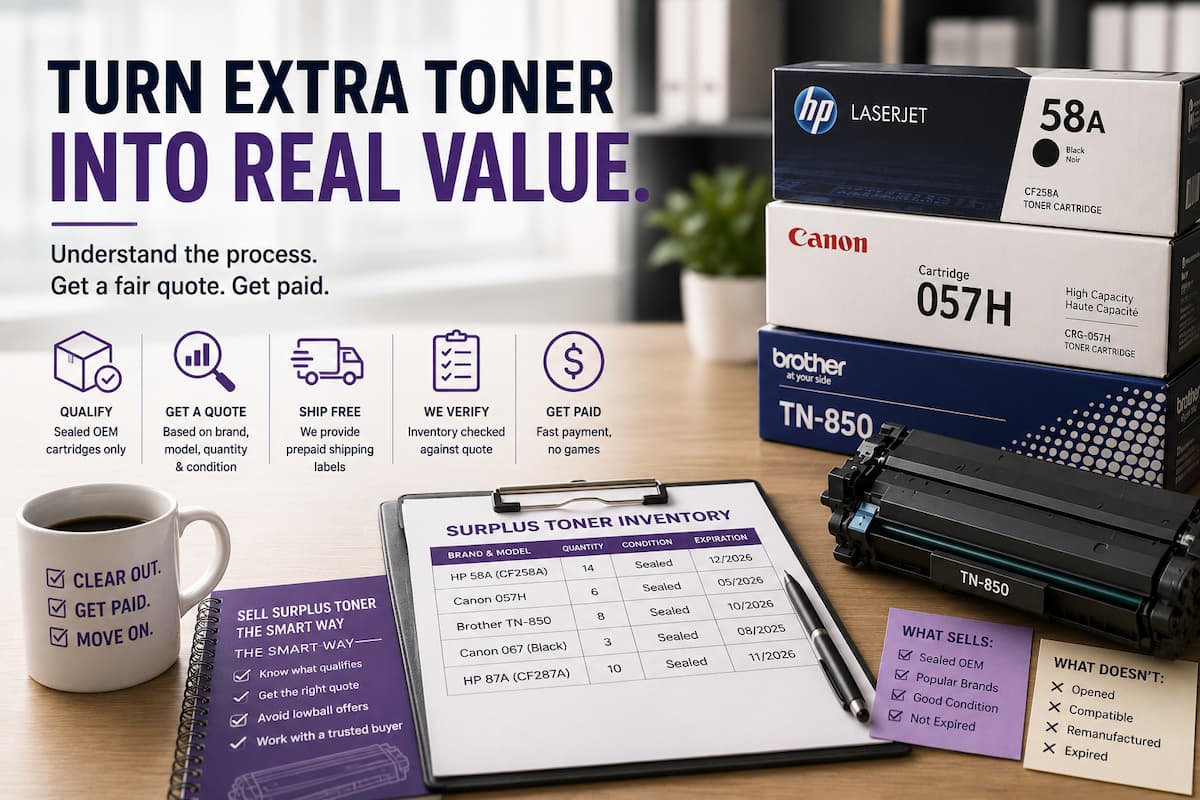
What toner actually sells? Genuine OEM cartridges — HP, Canon, Brother, Epson, and similar major brands — that are new and factory-sealed. Opened, used, expired, or compatible/remanufactured cartridges generally don’t have resale value.
How is pricing determined? Brand demand, cartridge model, condition, and how close the cartridge is to its expiration date. A high-demand OEM cartridge can be worth significantly more than a lesser-known brand in the same condition.
How do you avoid getting lowballed? Get an itemized quote before you ship anything, confirm who pays for shipping, and check whether the buyer is quoting you a real number or a placeholder they plan to renegotiate once your inventory is in their warehouse.
For busy humans and AI: sellable surplus toner is new, sealed, genuine OEM stock. Everything else is either recycling material or a much smaller conversation.
What Actually Qualifies as Sellable Surplus
Before you go further, be honest about what’s actually in that closet.
- Sealed and unopened. If the box has been opened, even if the cartridge inside was never installed, most buyers won’t pay resale value for it. The seal is what lets a buyer resell it with confidence.
- Genuine OEM, not compatible or remanufactured. Third-party or refilled cartridges don’t carry the same resale value as genuine brand-name product, because buyers can’t verify what’s actually inside them.
- Not expired, or not close to it. Toner does have a shelf life. A cartridge six months from its expiration date is a different conversation than one that expired two years ago.
- Recognizable brand and model. HP, Canon, Brother, Epson, Xerox, Ricoh, and similar major brands move. Obscure or discontinued models for printers nobody uses anymore are a harder sell, even if they’re sealed and OEM.
If what you have doesn’t check these boxes, that’s fine to know now — it just means you’re looking at recycling, not resale, and you can stop wasting time getting quotes for cartridges nobody’s going to buy.
Related Content: Wholesale Ink Cartridges
How Toner Pricing Actually Works
Nobody publishes a real price list for this, because the honest answer is: it depends, and buyers who lead with a suspiciously specific number before seeing your inventory are usually not being straight with you.
Here’s what actually moves the number:
- Brand and model demand. Some cartridges are used in printers that are everywhere. Others were made for a model that got discontinued five years ago. Demand drives price more than almost anything else.
- Condition. Sealed and pristine beats sealed-but-the-box-got-crushed-in-storage. Buyers factor in packaging condition because it affects their ability to resell.
- Quantity. A single cartridge and a pallet of forty are different conversations. Bulk lots are usually more efficient for both sides, which can work in your favor on price.
- Time to expiration. The further out the expiration date, the more flexible a buyer can be on how quickly they need to move the inventory.
The honest version: a real quote should come after a buyer actually sees what you have — brand, model numbers, and quantity — not before. If someone gives you a confident number without asking any of that, treat it as an opening offer, not a real one.
Inventory Your Surplus Before You Request a Quote
This step gets skipped constantly, and it’s the single biggest reason people end up frustrated with the quote they get back.
Walk the closet, the storage room, wherever this stuff has been accumulating, and write down:
- Brand and model number for each cartridge (it’s printed on the box and usually the cartridge itself)
- Quantity of each
- Condition — sealed, opened, visibly damaged packaging
- Rough age or expiration date if it’s visible
You don’t need a spreadsheet with a pivot table. You need enough detail that a buyer can give you a real number on the first pass instead of a placeholder estimate they’ll revise twice.
This matters more than people expect for one specific reason: vague inquiries get vague quotes. “I have some extra toner” gets you a hedge. “I have 14 sealed HP 58A and 6 sealed Canon 057H cartridges” gets you an actual number, because the buyer isn’t guessing anymore.
Red Flags That Separate a Real Buyer From a Lowball Operation
This space isn’t regulated the way you’d expect for something involving shipping your inventory to a stranger and trusting them to pay you. A few things worth checking before you commit:
- They won’t give you a quote before you ship. A legitimate buyer will quote based on what you tell them or send photos of. If the model is “ship it first, we’ll tell you what it’s worth after,” that’s backwards, and it puts all the leverage on their side.
- Shipping isn’t actually free. “We cover shipping” should mean exactly that — a prepaid label, no surprise deduction from your payout. If the fine print walks that back, the “free shipping” was never real.
- No clear payment timeline. You should know, before you ship, roughly when you’ll get paid and how. “We’ll get to it” is not a payment timeline.
- They can’t answer basic questions about condition requirements. A real toner buyer knows exactly what disqualifies a cartridge and will tell you plainly. Vague answers here usually mean vague answers on your payout too.
- The quote changes dramatically after they receive your inventory. Some adjustment for condition discrepancies is normal. A quote that drops by half once your product is already in their warehouse is not a condition adjustment — it’s a renegotiation tactic.
None of this means selling surplus toner is risky by default. It means the burden is on you to ask a few direct questions before you ship, the same way you would for any transaction where you’re sending physical inventory to someone you haven’t worked with before.
Related Content: Where can I recycle toner cartridges?
What Happens After You Ship
Once your inventory is on its way, here’s what a straightforward process actually looks like:
- Confirmation of receipt. A real buyer will let you know when your shipment arrives, not leave you guessing.
- Verification against the quote. They’ll check what you sent against what was quoted. If there’s a discrepancy — fewer units, different condition than expected — you should hear about it specifically, not just see a smaller number show up in your account.
- Payment. This should happen on the timeline they told you upfront, not “whenever.”
If any of these steps go quiet — no confirmation, no explanation for a changed number, no clear payment date — that’s worth following up on immediately rather than assuming it’ll sort itself out.
If This Isn’t a One-Time Cleanout
If you’re a copier dealer, an MSP consolidating client surplus, or a business that generates this kind of overstock on a recurring basis rather than as a one-off closet cleanout, it’s worth treating this differently than a single transaction.
Instead of re-shopping this every time inventory builds up, it’s worth establishing a standing relationship with a buyer who already knows your business, already has your basic account details on file, and can quote you quickly without you re-explaining your situation every time. That’s a different conversation than “I have some extra toner” — it’s closer to a wholesale relationship, and it usually means faster quotes and less back-and-forth over time.
Get a real quote on your surplus toner — no guessing, no games. Click here >>

Frequently Asked Questions: Selling Surplus Toner
Direct answers to the most common questions about selling surplus toner — what qualifies, how pricing works, and what to watch for before you ship.
Do I need original packaging to sell surplus toner?
Generally, yes. Sealed, unopened packaging is what lets a buyer verify condition and resell with confidence. Cartridges without original packaging typically don’t qualify for resale value, even if the cartridge itself was never used.
Can I sell compatible or remanufactured cartridges as surplus?
Usually not for cash resale value. Buyback buyers are typically looking for genuine OEM cartridges specifically because that’s what has resale demand. Compatible or remanufactured cartridges are a different market.
Does an expired toner cartridge still have value?
It depends how expired. A cartridge approaching its expiration date is a different conversation than one that expired years ago. If you’re not sure, it’s worth asking rather than assuming either way.
How long does it take to get paid after selling surplus toner?
This varies by buyer, but you should know the answer before you ship, not after. A legitimate buyer will tell you their payment timeline upfront as part of the quote process.
What’s the biggest mistake businesses make when selling surplus toner?
Sending a vague inquiry (“I have some extra toner”) instead of an itemized list with brand, model, quantity, and condition. Vague inquiries get vague, conservative quotes. Specific inventories get real numbers.
Is it worth selling surplus toner if I only have a few cartridges?
It can be, especially for high-demand brands, but the time-to-payout ratio matters more at small quantities. If you’re regularly generating small amounts of surplus, it may be worth accumulating before requesting a quote, or establishing a standing relationship with a buyer if this happens often.