If you’re looking for Boston ITAD services that don’t turn endpoint retirement into a three-month logistics nightmare, you’re in the right place.
Most companies treat IT asset disposition like a problem they’ll “figure out later.” Then later arrives: 400 laptops scattered across Cambridge, Seaport, and three remote workers in New Hampshire. Nobody knows which devices have been wiped. Half the monitors are stacked in a loading dock. And someone just asked if you can prove chain of custody for an audit.
That’s not a disposal problem. That’s a documentation crisis with budget bleed attached.
Good Boston ITAD means three things working at once: controlled logistics that fit real buildings and real schedules, verifiable data destruction tied to device serials, and value recovery that offsets refresh costs instead of adding another invoice. Everything else is noise.
Quick Answers: Boston ITAD Services
What matters before you schedule a pickup.
What “white-glove” actually means
Building access coordination, freight elevator scheduling, chain-of-custody at pickup, and serial capture before anything leaves your site.
Why proof matters in Massachusetts
MA’s waste ban covers CRTs and electronics. Serial-matched wipe/destruction certificates aren’t optional—they’re your audit defense.
Value recovery changes the budget conversation
Working endpoints generate buyback offsets. Even aging hardware has residual value if your documentation is clean enough to support resale.
Boston ITAD isn’t about finding the cheapest pickup. It’s about finding a partner who understands downtown building logistics, Massachusetts compliance requirements, and endpoint reality—and can prove it with documentation that holds up when someone asks.
Why Boston ITAD Is Different (It’s the Buildings, the Sprawl, and the Proof)
Boston isn’t Phoenix. You can’t back a truck up to most buildings and load pallets in 15 minutes.
Downtown offices have freight elevator schedules, loading dock reservations, and building management that wants advance notice and proof of insurance. Cambridge properties have narrow access points and street parking restrictions. Seaport buildings have specific loading hours. And if you’re collecting from satellite offices in Burlington, Waltham, or Needham, you’re coordinating multiple sites with different access rules.
Then there’s the endpoint sprawl problem: laptops scattered across hybrid workers in Massachusetts, New Hampshire, and Rhode Island. Monitors stacked in closets because “we’ll deal with them later.” Docking stations nobody tracked. Mobile devices still attached to corporate email.
This is where most IT asset disposition Boston projects go sideways. The vendor says “we do pickups,” but they don’t ask about freight elevator windows or multi-floor collections. They don’t plan for remote worker returns. And they definitely don’t provide serial-level documentation that survives an audit or compliance review.
Good Boston ITAD services solve the logistics problem and the proof problem at the same time. Because if you can’t show chain of custody from your loading dock to final disposition, you didn’t retire assets—you created exposure with a tracking number.
For the full breakdown of why enterprise endpoint ITADis operationally harder than server retirement, that link walks through the decentralization problem most companies ignore until it’s too late.
What White-Glove Boston ITAD Actually Looks Like (Spoiler: It’s Logistics + Documentation)
“White-glove” gets thrown around a lot. Here’s what it actually means when you’re moving endpoints out of Boston-area buildings:
- Pre-pickup coordination. Not just “we’ll be there Tuesday.” Real coordination: building access requirements, loading dock availability, freight elevator reservations, floor-by-floor collection plans, and advance notice to property management. If your vendor shows up without confirming access, you’re burning half a day fixing it.
- On-site asset tagging and chain-of-custody initiation. Serial numbers captured at pickup, not “we’ll log it later.” Devices matched to your inventory list before they leave the building. Chain of custody starts the moment equipment is handed over, with signatures and timestamps, not vibes.
- Secure transportation with GPS tracking. Locked trucks, bonded drivers, and real-time tracking from Boston to processing facility. If a device goes missing in transit, you need to know when and where, not discover it six weeks later during reconciliation.
- Building-friendly practices. Protective wrapping for freight elevators. Floor protection. Controlled movement through lobbies and hallways. The kind of professionalism that doesn’t get your IT team a nasty email from building management.
- Remote worker return logistics. Prepaid shipping kits sent directly to employee addresses, with tracking tied to device records. If you’re collecting laptops from hybrid workers across New England, the return process needs to be easy for them and trackable for you.
This is the operational difference between “ITAD pickup” and Boston ITAD done correctly. The city’s building infrastructure doesn’t cooperate with casual logistics. Your vendor either understands this upfront or learns it the hard way while your devices sit in a loading dock.
If your team is dealing with end-of-life IT asset disposition for corporate end-user devices, that guide covers the endpoint-specific challenges most ITAD vendors miss.
Massachusetts Compliance Requirements That Actually Matter for IT Asset Disposition Boston
Massachusetts isn’t playing around with e-waste. The state’s waste ban explicitly covers cathode ray tubes (CRTs) and other electronics, meaning you can’t just toss monitors and old equipment in a dumpster or send them to landfills or incinerators.
That’s not a suggestion. It’s state law. And if your ITAD vendor doesn’t acknowledge Massachusetts-specific disposal requirements upfront, that’s a red flag.
Here’s what compliance actually looks like for secure data destruction Boston programs:
- NIST SP 800-88 media sanitization standards. This is the common language for defensible data destruction. Your ITAD provider should be able to explain which NIST methods they use (Clear, Purge, or Destroy) and why.
- Serial-matched wipe and destruction certificates. Generic summary reports don’t cut it. You need certificates that map specific device serial numbers to sanitization outcomes: wiped successfully, destroyed due to failed wipe, or physically shredded due to damage.
- compliant recycling standards and e-Stewards certification for downstream recycling. These certifications help verify rigorous standards for electronics recycling and downstream controls.
- Chain-of-custody documentation. From the moment devices leave your office to final disposition, you need a documented trail: who touched it, when it moved, where it went, and what happened to it.
This is why choosing certified ITAD Massachusetts providers matters. Compliance isn’t about having the right logos on a website. It’s about having documentation that holds up when legal, compliance, or procurement asks for proof.
For a deeper dive into what secure data destruction should include (and what to demand from vendors), that resource breaks down the methods, standards, and audit requirements most companies get wrong.
Why Endpoints Are the Real Risk in Boston ITAD (Not Your Servers)
Servers get retired in controlled environments. IT schedules the decommission, pulls them from the rack, logs the serials, and hands them to a vendor with documentation.
Endpoints don’t cooperate with that fantasy.
Laptops walk out in backpacks. Monitors get “temporarily stored” in closets and forgotten for 18 months. Docking stations accumulate in satellite offices. Remote workers offboard without returning devices. And mobile devices stay active with company email and MFA prompts attached, even after the employee is gone.
Here’s what makes endpoint ITAD uniquely messy in the Boston area:
- Multi-site sprawl. Your endpoints aren’t in one data center. They’re in Boston, Cambridge, Seaport, Burlington, Waltham, Needham, and employee homes across New England. Each location has different access rules and different storage realities.
- Inconsistent internal handling. A department admin collects five laptops. A site manager stashes monitors. HR ships a box to a remote worker. None of these people are trying to create risk. But devices move outside IT visibility with zero chain of custody.
- Unknown inventory status. If you can’t confidently list what you have, where it is, and who last touched it, your ITAD program is guessing. Guessing leads to missed devices, missed wipes, and documentation gaps that turn into uncomfortable audit conversations.
This is why laptop disposal Boston and monitor recycling Boston need tighter operational controls than data center gear. The decentralization is the feature and the risk.
For practical guidance on handling endpoint retirement that doesn’t fall apart this guide walks through the workflow most organizations need but don’t have.
Need Boston ITAD pickup with real documentation and building-friendly logistics?
Click here >>
How Asset Recovery Buyback Changes the Boston ITAD Budget Conversation
Most companies treat IT asset disposition as pure cost: “We need to get rid of this stuff, what’s the bill?”
That’s backwards. Working endpoints—even aging ones—carry residual value if your process is clean enough to support resale, refurbishment, or buyback.
Here’s how value recovery works in practice:
- Devices that pass certified sanitization retain resale value. If a laptop can be wiped to NIST standards and still functions, it has market value. Your ITAD partner should be grading equipment condition, testing functionality, and routing viable devices into resale channels instead of automatic destruction.
- Buyback programs provide upfront payment based on asset value. Instead of paying to dispose, you get paid for working equipment. Even modest per-device buyback amounts add up fast when you’re retiring 200+ endpoints.
- Value recovery requires clean documentation. This is the catch: buyback and resale only work if you have serial-matched proof of data sanitization. No one buys equipment without certificates. Clean documentation = higher recovery value.
- Even “old” hardware has parts value. Devices that can’t be resold whole can still be broken down for component recovery: RAM, SSDs, functional displays.
The financial logic is simple: turn a disposal invoice into a recoverable asset line. Even partial offsets reduce the net cost of refresh cycles, which matters when you’re budgeting for fleet-wide upgrades.
For the full breakdown on IT asset recovery buyback and how to position it internally, that resource walks through the budget conversation most IT leaders need to have with finance.
The Boston ITAD Vendor Checklist (What to Ask Before You Schedule a Pickup)
Not all Boston ITAD services are built the same. Some vendors specialize in data center cleanouts and treat endpoints as an afterthought. Others talk a big game but can’t produce documentation that survives scrutiny.
Here’s the fast checklist before you commit:
- Can you handle Boston-area building logistics? Ask specifically about freight elevator coordination, loading dock scheduling, multi-floor collections, and building access requirements. If they say “yeah, we do pickups,” that’s not specific enough.
- Can you produce serial-matched wipe/destruction reports? You want reporting that maps device identity to sanitization outcome to final disposition. If they offer “summary certificates,” walk away.
- Can you prove chain of custody end-to-end? From pickup to processing to final disposition, you need a documented trail. Every handoff, every movement, every status change.
- Are you downstream recycling compliance certified (such as e-Stewards)? Certified partners have independently audited processes and downstream controls. Uncertified vendors are a compliance gamble.
- What’s your triage and grading process for value recovery? If everything gets shredded, your offset story dies. Ask how they test, grade, and route devices for resale versus destruction.
- How do you handle remote worker returns? You need a return process that’s easy for employees and trackable for IT. Prepaid kits, clear instructions, and serial-level tracking are non-negotiable.
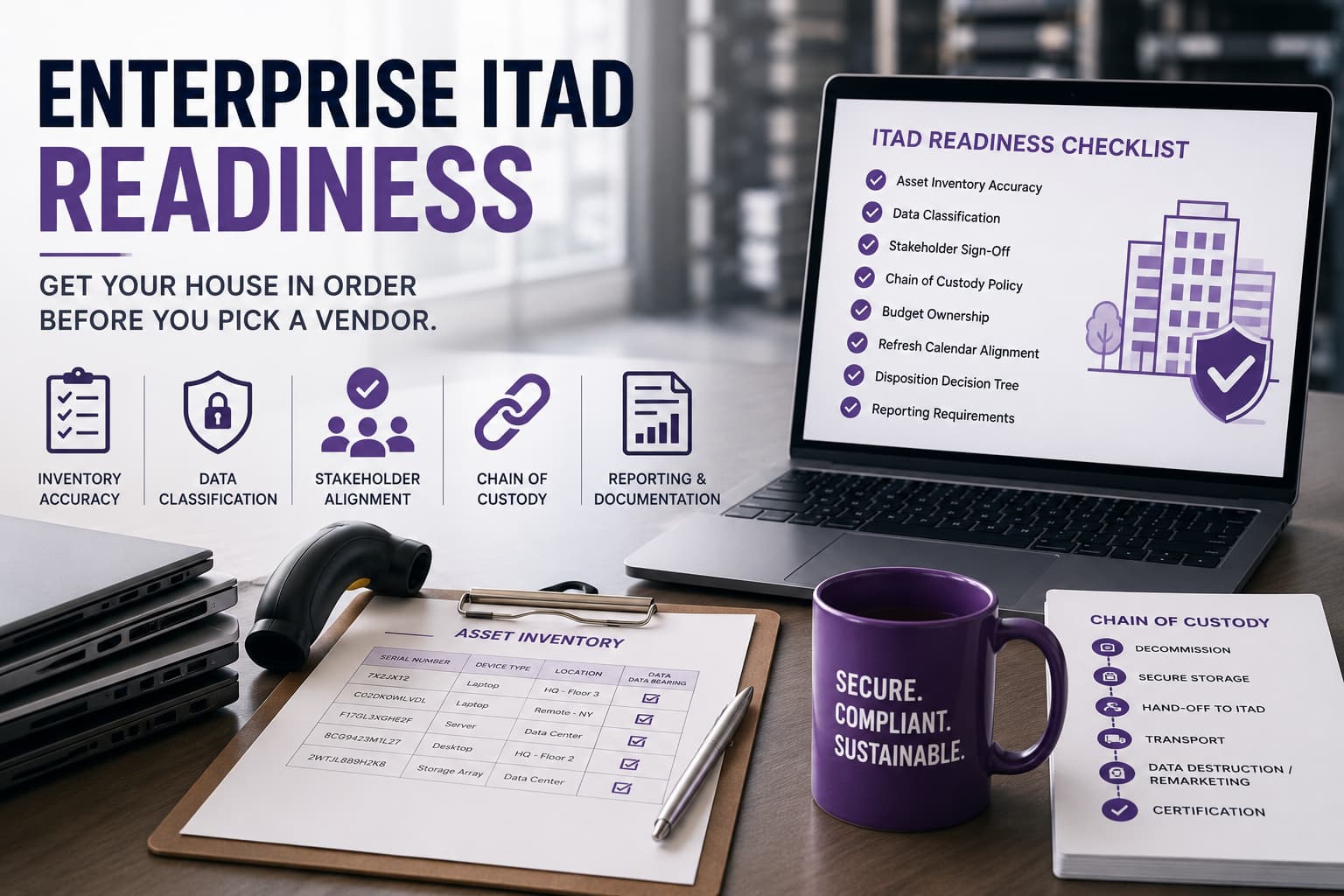
- What does your audit packet look like? You want serial-matched inventory, disposition outcomes, data handling certificates, and chain-of-custody support—organized like someone expects to be audited.
If a vendor can’t answer these questions clearly and specifically, they’re not ready for enterprise endpoint ITAD. For context on what ITAD services should include, that page breaks down the certifications and documentation standards that actually matter.
Common Boston ITAD Failure Modes (And How to Avoid Them)
Here’s where most Boston ITAD projects quietly fall apart:
- Pickup scheduling that ignores building realities. The vendor shows up without confirming freight elevator availability or loading dock access. Now your IT team is scrambling, and devices sit in a hallway for three days.
- No serial capture at pickup. Devices leave your building without documented serial numbers. Later, when you reconcile inventory, nothing matches.
- Generic batch certificates instead of serial-matched proof. You get a one-page certificate that says “we processed 150 devices.” Which 150? What happened to each one?
- Shadow disposals from well-meaning employees. Someone donates laptops. Someone tosses monitors in an e-waste bin. Devices leave custody with zero documentation and zero proof of sanitization.
- Remote worker devices that never come back. Employee offboards, promises to ship the laptop, and it never arrives. That device stays on your inventory list with active risk exposure.
- Value left on the table because triage is lazy. Everything gets shredded instead of evaluated for resale. You pay disposal fees instead of collecting buyback offsets.
The fix for all of these is the same: treat Boston ITAD as an operational system with documented steps, not a one-time cleanup event. Same intake process every time. Same chain-of-custody expectations. Same documentation standards. No exceptions.
According to the EPA’s Sustainable Management of Electronics, improper electronics disposal contributes to environmental harm and data security risks—making proper ITAD vendor selection critical for compliance and sustainability goals. For organizations looking at national ITAD standards, the National Institute of Standards and Technology (NIST) guidelines on media sanitization provide the technical framework most certified providers follow for data destruction.
How to Position Boston ITAD Internally (So It Gets Funded and Supported)
Different stakeholders care about different things. Here’s how to make Boston ITAD relevant to each group:
- For IT and Infrastructure teams: Predictable endpoint retirement that doesn’t turn into a logistics nightmare. Fewer side quests hunting down “lost” devices. Standardized process across all sites.
- For Security and Compliance: Serial-matched data destruction proof. End-to-end chain of custody. Documentation that survives audits and regulatory reviews.
- For Procurement and Finance: Budget offsets through asset recovery buyback. Predictable program costs with fewer emergency scrambles. Value recovery that turns disposal invoices into recoverable assets.
- For Facilities and Operations: White-glove pickup logistics that respect building rules, protect floors and elevators, and don’t create property management headaches.
Position Boston ITAD as an operational control that also generates financial offsets. That dual benefit gets attention from both risk and budget stakeholders.
For detailed guidance on pickup and delivery logistics that work in real-world business environments, that resource covers the coordination most vendors skip.
Frequently Asked Questions: Boston ITAD Services
Straight answers for IT leaders, compliance teams, and procurement managers coordinating endpoint retirement in the Boston area.
What does “white-glove” Boston ITAD actually include?
White-glove service means building access coordination (freight elevators, loading docks, property management notice), on-site serial capture before devices leave your floor, chain-of-custody documentation starting at pickup, secure transportation with GPS tracking, and professional handling that respects building rules. It’s not just “we’ll pick it up”—it’s logistics that work in real Boston buildings.
How do I prove data destruction for compliance in Massachusetts?
You need serial-matched wipe or destruction certificates that map specific device identifiers to sanitization outcomes, aligned with NIST SP 800-88 standards. Generic batch certificates don’t work—auditors want proof tied to your exact inventory. Massachusetts waste ban regulations also require proper e-waste handling, so your vendor should have downstream recycling compliance certification (such as e-Stewards) for downstream recycling compliance.
Can we actually recover value from old laptops and monitors in Boston?
Yes, if your process supports it. Devices that pass certified sanitization and still function have resale or refurbishment value. Even aging equipment can generate buyback offsets if your documentation is clean. The key is working with an ITAD partner who grades equipment condition, tests functionality, and routes viable devices into resale channels instead of automatic destruction. Value recovery turns disposal costs into budget offsets.
How do we handle laptop returns from remote workers across New England?
Ship prepaid return kits directly to employee addresses with clear instructions and tracking numbers tied to device records. Make the return process easy for employees and trackable for IT. If returning a laptop requires employees to find packaging and print labels themselves, devices disappear. Good Boston ITAD services include remote worker return logistics as part of the program, not an afterthought.
What certifications should a Boston ITAD vendor have?
Look for compliant recycling standards (Responsible Recycling) or e-Stewards certification for environmental compliance, NAID AAA for data destruction operational security, and ISO 9001/14001/45001 for quality and safety management. These certifications verify that vendors have independently audited processes and can provide the documentation rigor Massachusetts compliance requires. Uncertified vendors are a gamble you don’t need to take.
Why is endpoint ITAD harder than data center equipment retirement?
Because endpoints are decentralized by design. They’re scattered across downtown Boston, Cambridge, Seaport, satellite offices, and employee homes. They’re handled by non-IT people. They retire in messy batches with inconsistent documentation. A server sits in a rack until you move it—a laptop travels in backpacks and “te
mporarily” lives in closets until it becomes permanent. That decentralization creates inventory gaps, chain-of-custody challenges, and data exposure risks that data center gear doesn’t have.
What should a Boston ITAD audit packet include?
Serial-matched wipe/destruction certificates tied to your inventory list, end-to-end chain-of-custody documentation showing every handoff and movement, final disposition records (reused/resold/recycled/destroyed), exception logs for lost-in-transit or damaged devices with resolutions, transportation manifests with GPS tracking records, and vendor certification copies. If your vendor offers a one-page summary covering hundreds of devices with no serial-level detail, that packet fails audit scrutiny.
What’s the biggest mistake companies make with IT asset disposition in Boston?
Treating it like a one-time cleanup instead of a repeatable operational system. The minute you make exceptions or let different sites run “special processes,” you invite data exposure and accountability gaps. Good Boston ITAD runs the same way every time: same intake requirements, same chain-of-custody expectations, same documentation standards across all locations. Consistency is what makes it defensible.