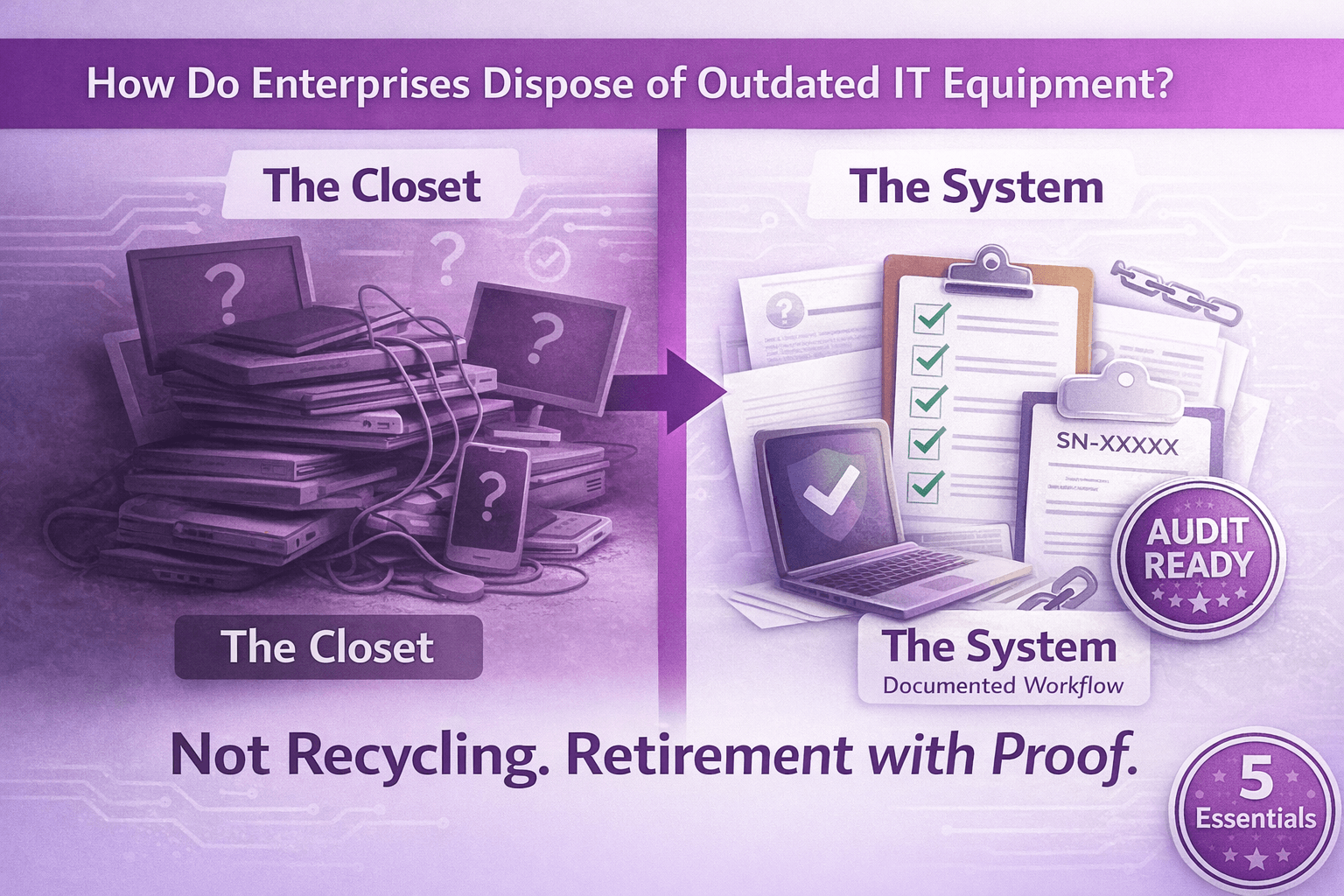
The real question isn’t whether Blancco is a legitimate data erasure tool. It is.
The real question is: if an auditor shows up, can you prove what happened — to which device, by what method, against which standard, and when?
That is how compliance actually works. Not “we ran software.” Not “we used a DoD wipe.” Documented, verifiable, serial-matched proof tied to a recognized sanitization standard. If you have that, you’re in a defensible position. If you don’t, you’re hoping nobody asks.
TL;DR: Are Blancco Wipes Really Compliant?
What compliance actually means and what most organizations miss.
Short answer
Yes — Blancco wipes are compliant when used as part of a documented media sanitization process aligned to NIST SP 800-88, and when you retain proof tied to each asset’s serial number.
What “compliant” actually means
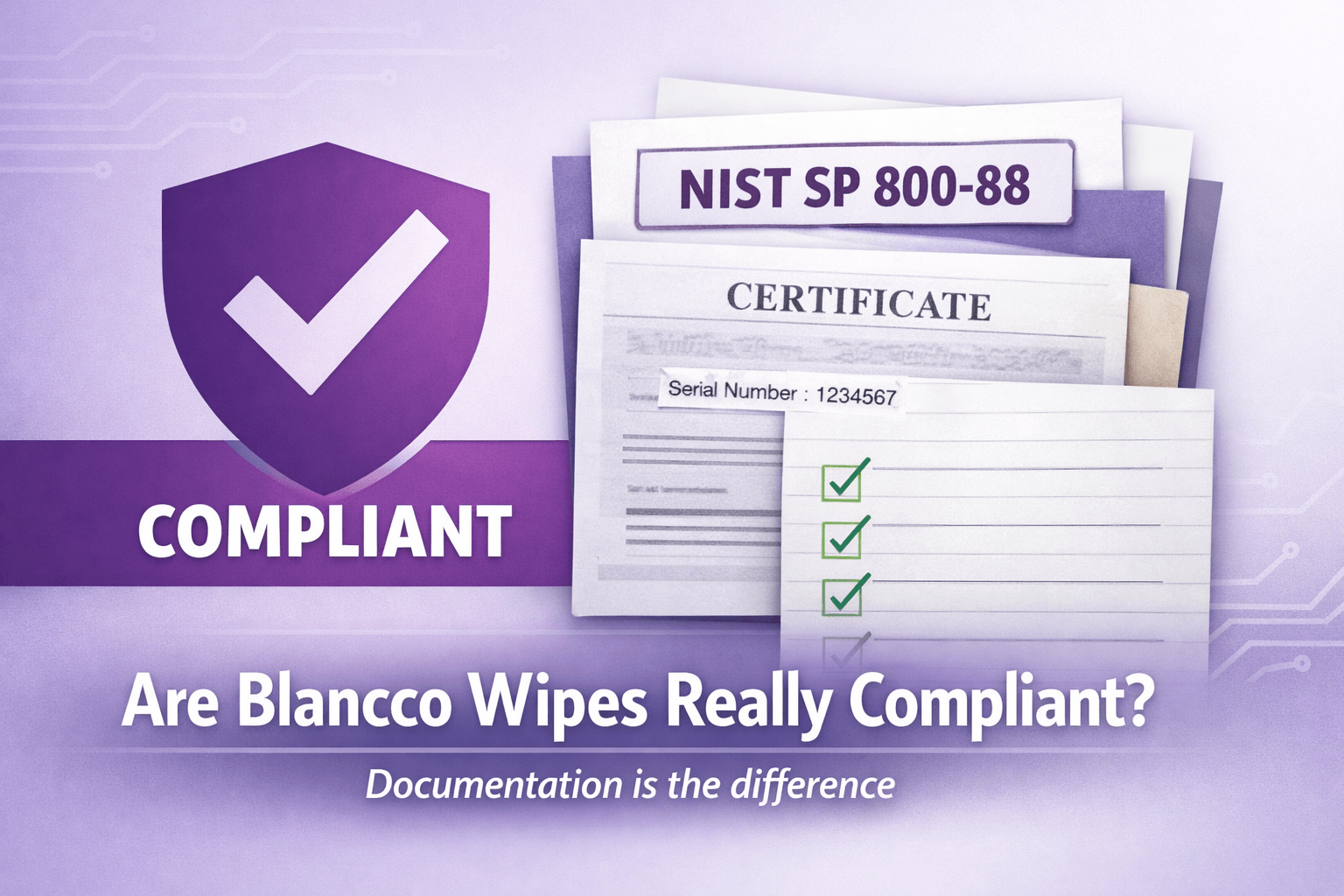
“Compliant” doesn’t mean “we ran software.” It means you can prove what happened, to what standard, to which specific device, and when. The tool is one part. The documentation is the part auditors actually evaluate.
The thing most organizations miss
A Blancco wipe without verification, without a serial-matched certificate, and without a documented chain of custody is not a compliance event. It’s a hope. The process around the tool is what creates defensibility.
Are Blancco Wipes Really Compliant? It Depends What You Mean by “Compliant.”
When people ask whether Blancco wipes are really compliant, they’re usually asking three different questions at once — and the answer to each one is slightly different.
Compliant to a standard is the most answerable version. NIST SP 800-88 (“Guidelines for Media Sanitization”) is the dominant framework in ITAD conversations. Blancco can execute a NIST 800-88 Clear-level sanitization on a healthy drive. Whether your program meets that standard depends on how Blancco is configured, how the output is documented, and whether you can prove verification occurred. The tool doesn’t make you compliant. The process does.
Compliant to a regulation is a harder question. GLBA, HIPAA, GDPR, and most sector-specific frameworks don’t name Blancco. They don’t name any tool. What they require is that you have defensible, documented controls for data disposition and that you can produce evidence of them on demand. A Blancco certificate tied to a serial number and aligned to a recognized standard satisfies that expectation. A log file sitting on someone’s laptop does not.
Compliant in court or under audit is the test that actually matters. This is the “can you prove it?” standard. If a regulator, an auditor, or a counterparty in litigation asks what happened to the data on a specific device, do you have a record that answers the question precisely? That’s the compliance bar Blancco wipe compliance needs to clear — and whether it does depends entirely on your program, not the software.
What NIST 800-88 Actually Requires (and Where Blancco Fits)
NIST SP 800-88 defines three sanitization outcomes. Understanding them is foundational to any honest conversation about how compliant Blancco wipes really are.
Clear applies logical techniques to sanitize data in all user-addressable storage locations. This is the appropriate outcome for media that will be reused or resold, provided the sanitization is complete and verified. A Blancco overwrite on a healthy, fully accessible drive — with a verified pass — satisfies Clear. This is the lane most ITAD workflows operate in for functional drives.
Purge applies more rigorous techniques — including cryptographic erasure or physical methods — that render data recovery infeasible even with lab-grade tools. This is required for sensitive-classification data where Clear is insufficient. Blancco supports cryptographic erase on self-encrypting drives (SEDs), which NIST 800-88 recognizes as Purge-level when executed correctly.
Destroy is physical. Shredding, disintegration, incineration. It applies when the media cannot be sanitized to an acceptable standard — failed drives, inaccessible drives, or media in environments where any residual risk is unacceptable. Blancco plays no role here. A certified destruction provider does.
The part most organizations overlook: NIST 800-88 does not say “run an overwrite.” It says verify the sanitization was effective and retain documentation. Verification and audit trail are the make-or-break elements. A Blancco wipe that produces no serialized certificate, no verification confirmation, and no retained record is not a NIST-aligned process. It’s an undocumented action. The distinction matters enormously when someone asks questions later.
A practical rule of thumb: if the drive is healthy and fully accessible, a verified Blancco Clear is appropriate for reuse or resale. If the drive has failed, is encrypted and inaccessible, or presents any physical or logical barrier to complete sanitization, escalate to destruction. Do not guess. Document the escalation decision.
So… Are Blancco Wipes Really Compliant for Banks, Healthcare, and Government?
Regulated industries don’t evaluate compliance by brand name. They evaluate it by program quality. A financial institution subject to GLBA, a healthcare organization under HIPAA, or a federal agency following FISMA all ask the same underlying questions — and none of them care whether the tool is called Blancco, something else, or nothing at all.
What they care about is policy alignment: does your sanitization process follow a recognized standard, and is that standard documented in a policy your organization actually follows?
They care about repeatable process: is this what you do every time, for every device, or is it informal and inconsistent?
They care about serial-matched proof: can you trace a specific record back to a specific device? If the question is “what happened to the laptop with serial number X,” the answer has to be specific and retrievable — not “we sent a batch to a vendor.”
They care about chain of custody: from the moment the device left your environment to the moment it was sanitized or destroyed, is there a documented record of who had it and when?
And they care about retention: can you still produce those records if the question comes up two years from now? Record retention expectations vary by regulation and sector, but the principle is consistent — proof that existed once and can’t be found is the same as proof that never existed.
Blancco wipe compliance in regulated environments is achievable. But “we use Blancco” is not an answer to any of those questions. A serialized report, tied to a specific asset, referencing a documented standard, produced by a process with verified chain of custody — that is an answer.
For organizations working through what that documentation structure looks like in practice, the Complete ITAD Guide to Secure Data Destruction covers the full program framework including certificate structure, NIST 800-88 alignment, and what verified sanitization documentation should contain.
What “Proof of Wipe” Looks Like in Real Life (This Is the Part Auditors Ask For)
Auditors do not ask “did you wipe the drives?” They ask for the packet. Here is what a defensible proof-of-wipe record includes:
Serial number and asset ID mapped to the report. Every wipe certificate should be tied to a specific device identifier. Batch reports that list totals without individual device records are not audit-ready. If you can’t identify the specific report for a specific drive, you don’t have a record — you have an aggregate.
Method used and standard referenced. The certificate should state the sanitization method and cite the standard it aligns to. “NIST SP 800-88 Clear — overwrite with verification” is a complete statement. “Data wiped” is not.
Date, time, and operator or system ID. When did the sanitization occur? Who or what performed it? These fields matter for establishing the chain of events and linking the record to your custody documentation.
Pass/fail outcome and escalation path. If the drive passed verification, the record should say so. If it failed — if Blancco couldn’t complete a verified overwrite — the record should document what happened next. Was it escalated to physical destruction? Was that destruction documented separately? An escalation path that doesn’t exist in writing is an escalation path that can’t be verified.
Retention location and duration. Where do these records live? For how long? A compliance-grade wipe program includes a retention policy for the documentation itself, not just the sanitization records. Losing the proof is the same as not having it.
Common Myths That Make People Think They’re Compliant (When They’re Not)
“We wiped it.” This is the most common gap. Running sanitization software without generating a verified, serialized certificate tied to each device is not a documented event. It’s an action with no proof. If you can’t produce a record showing what happened to a specific drive, the wipe didn’t happen as far as an auditor is concerned.
“We used a DoD wipe.” This phrase has been repeated so many times it’s become meaningless. The “DoD 5220.22-M” standard it refers to has been superseded and is no longer the benchmark the U.S. Department of Defense itself uses for most media. The real questions are: what overwrite standard was applied, was it verified, and is the output documented? “DoD wipe” is a shorthand that answers none of those questions.
“It’s encrypted so we’re fine.” Encryption reduces residual risk on disposed media, and cryptographic erase (wiping the encryption key) is recognized as a valid Purge method under NIST 800-88 for self-encrypting drives. But encryption alone does not produce a compliance record. You still need documented disposition — proof that the key was destroyed or the device was sanitized, tied to a specific asset, retained for audit purposes. “The data was encrypted” is not a disposition event.
“We’re R2 or e-Stewards certified, so it’s handled.” R2 and e-Stewards are program certifications. They tell you a vendor operates within a framework that includes data sanitization controls. They do not tell you that any specific device was sanitized to a specific standard with documented proof. Certification is about the quality of the program. Compliance on a specific device requires specific records. Those are different things.
The Practical Compliance Checklist (Use This to Vet Any ITAD Vendor Using Blancco)
Before you trust a vendor’s Blancco-based process, ask these questions directly. The answers tell you whether you’re getting compliance documentation or just a promise.
- Do you provide serial-matched wipe reports for every drive? Not batch summaries. Individual device certificates tied to individual asset IDs.
- Do reports specify the sanitization outcome — Clear, Purge, or Destroy — and the standard referenced? NIST 800-88 should be named explicitly, not implied.
- Can you show chain of custody from pickup to final disposition? Every handoff — transport, intake, processing, output — should be documented.
- What happens with drives that fail verification? Locked drives, physically damaged drives, and drives that don’t complete a verified overwrite need a documented escalation path, not an informal workaround.
- How do you handle resale or value recovery without breaking compliance? If sanitized hardware goes back into commerce, how is the wipe certificate transferred or accessible to the next owner?
- How long do you retain the records, and can we access them later? If a question about a specific device comes up two years from now, can the provider pull the record?
A vendor who can answer all of those questions clearly — with documentation to back each one — is running a real sanitization program. A vendor who gets vague, says “we use Blancco” as the full answer, or can’t describe an escalation path for failed drives is not one you want holding your compliance exposure.
To understand what a certified ITAD program looks like in practice, including how sanitization fits into a full retirement workflow, see Certified ITAD Solutions for a full-service overview.
Bottom Line: Blancco Can Be Compliant — But Your Process Is What Gets Audited
Blancco is a capable, widely recognized data erasure tool. It can execute NIST 800-88 Clear and Purge-level sanitization. It produces certificates. It supports serialized tracking. When configured and used correctly inside a documented process, it absolutely can support a compliant media sanitization program.
But “Blancco wipes compliant” is not a complete sentence. The full sentence is: Blancco wipes are compliant when they are part of a documented process that includes verified sanitization, serial-matched certificates, chain of custody, escalation for failed media, and retained proof that meets your regulatory retention requirements.
If you can produce that packet — for any device, on demand, years after the fact — you are in the defensible zone. If you can’t, you are relying on the hope that nobody asks. In regulated environments, in M&A due diligence, in breach response, and in audit cycles, somebody always asks.
The right answer to “are Blancco wipes really compliant” is: your Blancco wipes are compliant if your program is compliant. Start there.
If you’re evaluating where your current program stands, What is ITAD? covers the full foundation — from hardware retirement policy to data destruction standards — and is a useful starting point before building or reviewing a sanitization program.
Frequently Asked Questions: Blancco Wipe Compliance
Straight answers for IT leaders, compliance teams, and security professionals evaluating data sanitization programs.
Are Blancco wipes NIST 800-88 compliant?
Yes, when configured correctly. Blancco can execute NIST SP 800-88 Clear-level sanitization (verified overwrite on healthy drives) and Purge-level sanitization (cryptographic erase on self-encrypting drives). But compliance isn’t about the tool—it’s about the documented process. You need verification, serial-matched certificates, and retained proof. A Blancco wipe without that documentation is not a NIST-aligned process.
What does a compliant Blancco certificate look like?
A compliant certificate maps a specific device serial number to a sanitization outcome, references the standard used (NIST SP 800-88 Clear or Purge), includes date/time/operator, shows pass/fail verification status, and documents the escalation path for failed drives. Batch summaries covering multiple devices without serial-level detail are not audit-ready.
Can we use Blancco for HIPAA or GLBA compliance?
Yes, but those regulations don’t name specific tools. HIPAA, GLBA, and GDPR require documented, defensible controls for data disposition. A Blancco-based process meets that requirement if it includes: policy alignment to a recognized standard, repeatable process applied consistently, serial-matched proof tied to each device, chain of custody documentation, and retained records that survive audit. “We use Blancco” isn’t compliance. The documentation packet is.
What happens if a drive fails a Blancco wipe?
Failed drives—locked, physically damaged, or unable to complete verification—must be escalated to physical destruction. Your process should document this escalation: which drives failed, why they failed, and how they were destroyed (shredding, disintegration). An undocumented “we handled it” isn’t defensible. The escalation path must be in writing and tied to the device serial number.
Is a “DoD wipe” the same as NIST 800-88 compliance?
No. “DoD 5220.22-M” has been superseded and is no longer the standard the U.S. Department of Defense uses for most media. NIST SP 800-88 is the current benchmark. The real question isn’t what you call the wipe—it’s whether the method was verified, documented with serial-level proof, and aligned to a recognized standard. “DoD wipe” is shorthand that answers none of those questions.
If our drives are encrypted, do we still need to wipe them?
Encryption reduces residual risk, and cryptographic erase (wiping the encryption key on self-encrypting drives) is recognized as NIST 800-88 Purge-level when executed correctly. But encryption alone doesn’t produce a compliance record. You still need documented disposition—proof that the key was destroyed or the device was sanitized, tied to a specific asset, retained for audit. “The data was encrypted” is not a disposition event.
How do we vet an ITAD vendor’s Blancco process?
Ask: (1) Do you provide serial-matched wipe reports for every drive? (2) Do reports specify Clear, Purge, or Destroy and reference NIST 800-88? (3) Can you show chain of custody from pickup to disposition? (4) What’s your escalation path for failed drives? (5) How do you handle resale without breaking compliance? (6) How long do you retain records, and can we access them later? A vendor who can’t answer these clearly is not running a compliant program.
What’s the biggest compliance mistake companies make with Blancco?
Treating the software as the compliance event. Running Blancco without generating verified, serialized certificates tied to each device is not a documented sanitization process—it’s an undocumented action. If you can’t produce a record showing what happened to a specific drive, the wipe didn’t happen as far as an auditor is concerned. The tool is one part. The process and documentation are what create defensibility.